AI Citation Monitoring & Opportunity Scoring: How to Secure Google SGE Visibility in 2026

Traditional SEO tracking is no longer sufficient. With Google's Search Generative Experience (SGE) and AI Overviews capturing a massive share of user clicks, simply ranking in the standard blue links is not enough. You can rank #1 on standard SERPs but remain entirely invisible in generative answers, leading to drops of up to 60% in organic traffic.
To protect your organic visibility in 2026, you must pivot to an AI Citation strategy—programmatically tracking where your domain is cited, detecting competitor vulnerabilities, and optimizing your pages for LLM retrieval.
Want to see if you can rank for this keyword?
Discover its exact search volume, CPC, difficulty score, and SERP competition in seconds.
See this keyword's difficulty score →What is AI Citation Monitoring?
AI Citation Monitoring is the continuous, programmatic tracking of a domain's references and link citations inside search engine LLM responses (like Google AI Overviews). It analyzes search engine result page (SERP) API responses to confirm whether target URLs are embedded within the generative answer's RAG citation graph.
Retrieval-Augmented Generation (RAG) engines crawl, index, and synthesize real-time web copy to form answers. AI Citation Monitoring tracks domain references, reducing the mean time to detection (MTTD) for lost generative visibility from a typical 14-day tracking delay down to less than 4 hours via automated webhooks. When a citation is lost, your system can trigger immediate content optimization alerts.
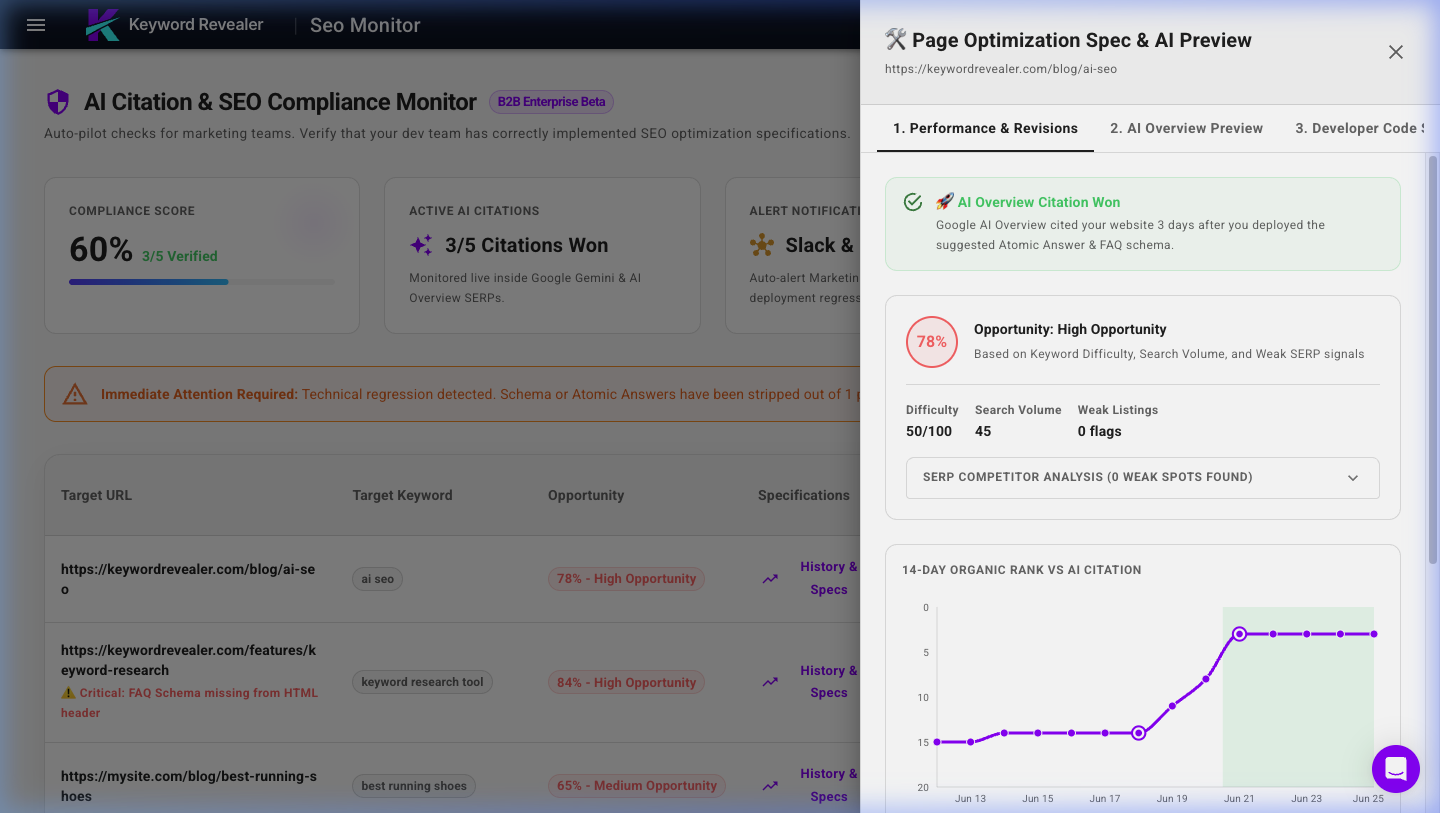
⚡ Try the Feature: Set up your first monitored keyword and track your citation performance in real-time using our new SEO Monitor dashboard.
How is the Keyword Opportunity Score Calculated?
The Keyword Opportunity Score is calculated via a weighted algorithm combining Keyword Difficulty (40%), Weak SERP Indicators (45%), and monthly Search Volume (15%). It identifies queries where the top organic results are dominated by weak platforms, forum domains, or unoptimized page titles, indicating a high probability of claiming an AI citation.
| Metric Vector | Algorithmic Weight | AI Search RAG Significance |
|---|---|---|
| Weak SERP Indicators | 45% | Identifies target spaces where user-generated content (Reddit/Quora) can be replaced by structured content. |
| Keyword Difficulty (KD) | 40% | Measures root domain backlink equity barriers across the top 10 positions. |
| Search Volume | 15% | Ensures the underlying query carries sustainable commercial intent. |
Not all search queries are equally open to AI citations. The score helps you identify the lowest-hanging fruit:
- Keyword Difficulty (40%): Lower KD means less overall competition from high-authority domains.
- Weak SERP Indicators (45%): Strong presence of low-barrier UGC sites (Reddit, Quora) is the single biggest predictor of an AI citation opportunity.
- Search Volume (15%): Prioritizes queries that drive meaningful monthly organic search sessions.
What are Weak SERP Indicators in LLM Search?
Weak SERP indicators are structural vulnerabilities in the top organic search results, specifically the presence of user-generated content (UGC) sites (like Reddit, Quora, or Medium) and pages with unoptimized title tags that fail to target the user query's semantic intent. These represent weak entry points that AI models frequently override or summarize.
When Google's AI models construct overviews, they evaluate the semantic density and authority of organic page results. If the top 10 results are dominated by forums (UGC) or lack query keywords in their title tags, the LLM will actively prioritize structured, expert content instead. Identifying these weak results allows you to target and replace them inside the AI citation box.
How Do You Optimize a Page for SGE Citation Compliance?
To optimize for SGE citation compliance, you must deploy a structured "Atomic Answer"—a 40-60 word direct response targeting a specific query—and bind it in JSON-LD FAQ Schema in the HTML header. This structured pair is easily parsed by search engine crawlers during RAG indexing, maximizing citation probability.
LLM crawlers are designed to extract factual statements quickly. By using an explicit Q&A structure:
- The Question: Target the query precisely as an H2 or H3.
- The Atomic Answer: Place your bolded, 40-60 word direct response immediately under the heading.
- The Schema: Mirror this exact Q&A pair in a
FAQPageJSON-LD Schema injected into the page header.
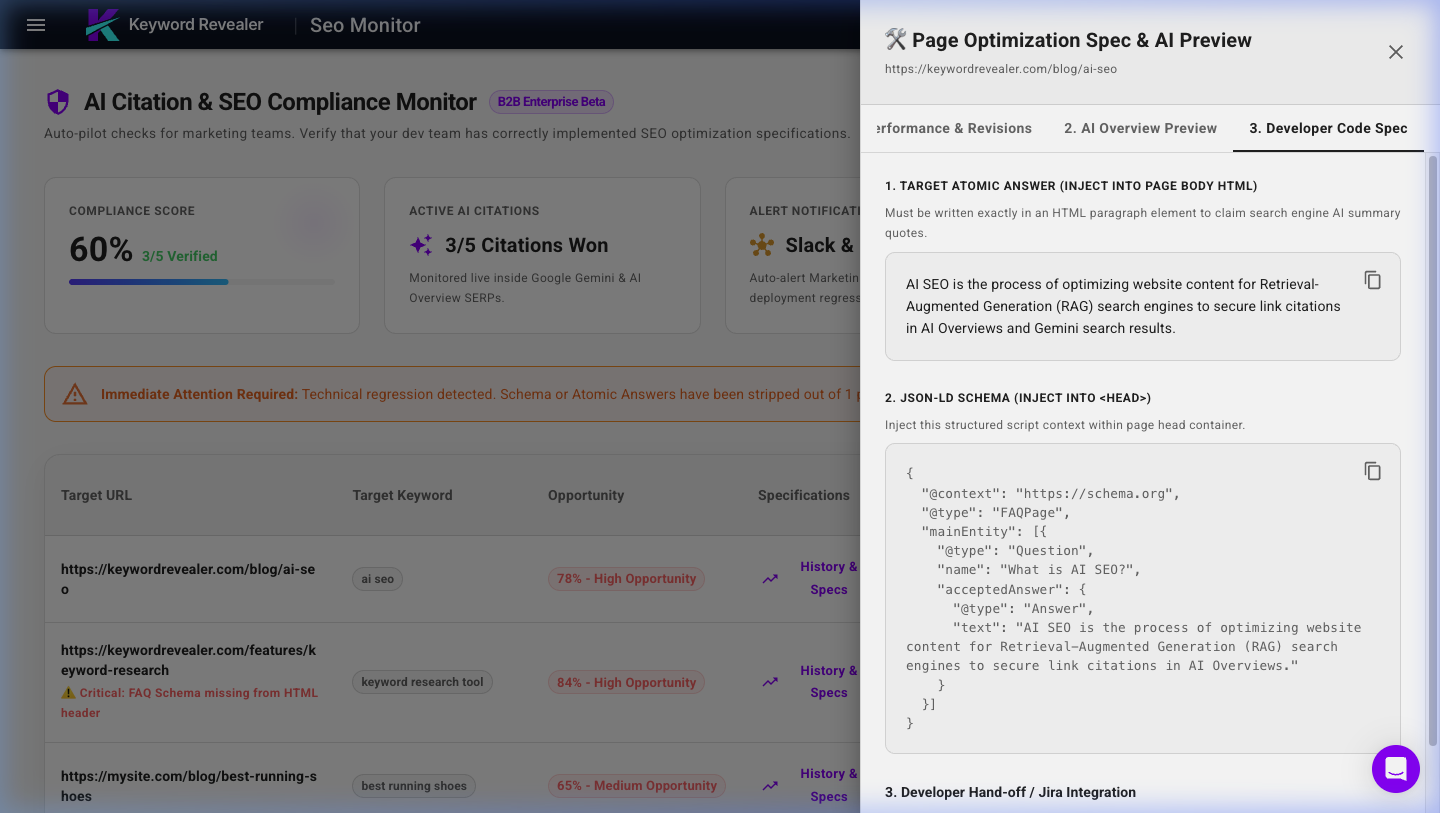
By aligning your on-page copy with the RAG retrieval window, you ensure maximum indexing efficiency and secure high-value generative search citations.
Try the keyword from this article
Find search volume, CPC, keyword difficulty score, and PPC competition in real-time.
Why Premium?
✓
Unlock 300+ daily searches (up from 6)✓
Accurate Keyword Difficulty and search trends✓
Competitor AI overview predictionsKR
Keyword Revealer Editorial Team
SEO Strategies & Product WorkflowsThe Keyword Revealer editorial staff is made up of veteran technical SEOs and content marketing strategists. They build actionable workflows and data-driven guides to help agencies, freelancers, and businesses secure page-one real estate.
Ready to find keywords you can actually rank for?
Keyword Revealer uses AI to predict your ranking potential before you write a single word.
Try Keyword Revealer FreeRelated Articles
Best AI Visibility (GEO) Tools in 2026: How to Track Your Brand in ChatGPT, Perplexity, Gemini and AI Overviews
September 25, 2026How to Check if ChatGPT Cites Your Website (and Perplexity, Gemini, AI Overviews)
September 25, 2026
Semrush Alternatives for Freelancers in 2026: Cheaper Keyword Research, Rank Tracking and AI Visibility
September 25, 2026