
Programmatic SEO in the Era of Answer Engines: How to Scale Content Without Getting Penalty-Blocked

Scaling organic search visibility is no longer about manually drafting individual articles. Programmatic SEO (pSEO) has emerged as the definitive framework for capturing long-tail commercial intent. However, as search engines evolve into LLM-driven Answer Engines, legacy pSEO techniques—like churning out thousands of thin, generic templates—are trigger-blocking spam penalties.
To succeed in 2026, programmatic architectures must deliver semantically dense, entity-rich layouts that bots can index and humans find highly valuable.
Want to see if you can rank for this keyword?
Discover its exact search volume, CPC, difficulty score, and SERP competition in seconds.
See this keyword's difficulty score →What is Programmatic SEO (pSEO) in 2026?
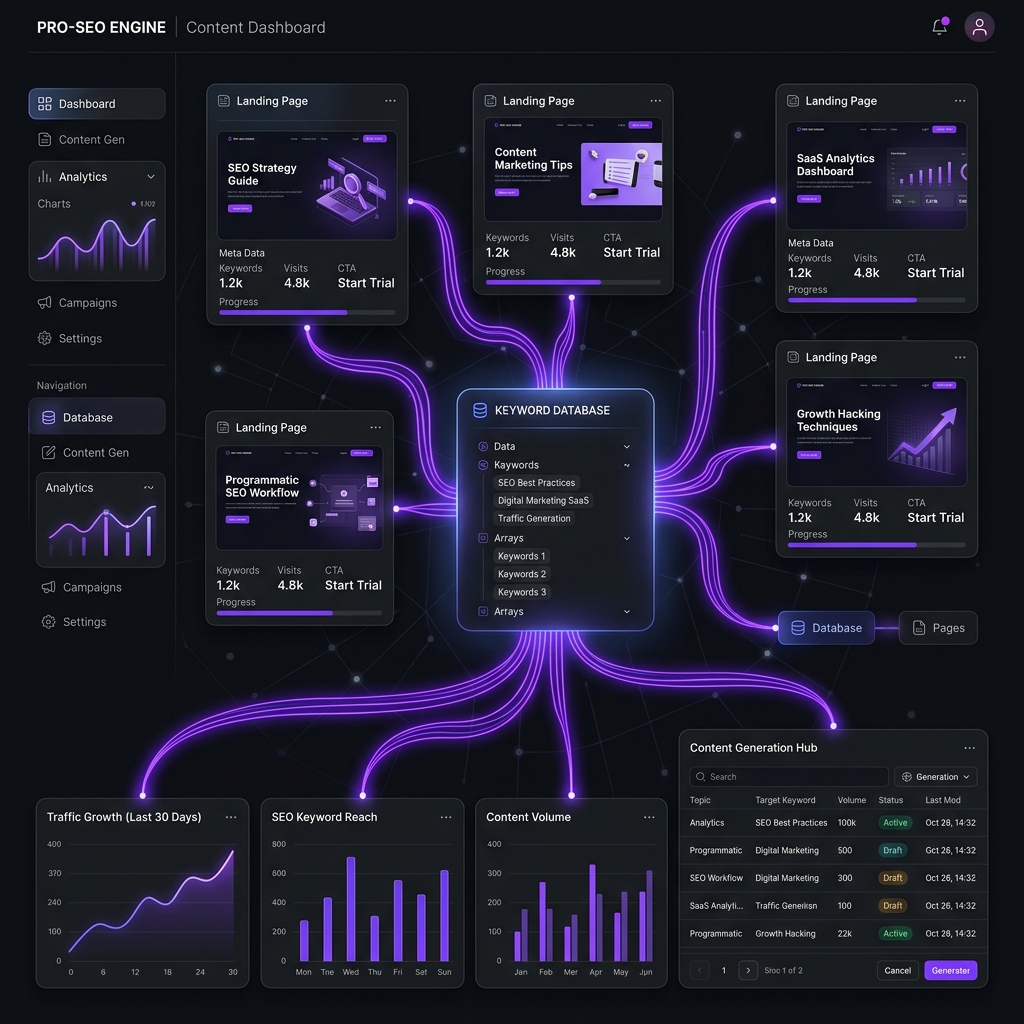
Programmatic SEO in 2026 is the automated, data-driven creation of thousands of high-quality landing pages targeting long-tail search queries. Rather than manual publishing, it leverages database-driven templates, structured schema, and LLM-assisted semantic writing to address granular user intent at scale. This allows you to blanket search results for highly qualified buyers.
Unlike traditional content creation, pSEO maps a database of terms (e.g., "Best [SaaS Tool] for [Niche Agency]") to a single, highly optimized page template. By using variables to swap out features, pricing, and comparison tables, a domain can target thousands of hyper-specific search intents with minimal human editing.
⚡ Try the Tool: Before launching a programmatic cluster, test your keyword difficulty and run search intent simulations using our AI Overview Simulator to verify your baseline AI visibility potential.
How Can You Prevent AI Search Engine Spam Penalties?
To prevent search engine spam penalties, you must avoid thin, repetitive AI content. Focus on programmatic templates that inject unique, proprietary database parameters, dynamic entity graphs, and expert-reviewed technical insights. Scraping and regurgitating existing web pages will trigger Helpful Content penalties.
Google's helpful content updates are specifically tuned to identify low-effort programmatic farms. To bypass these filters, your templates must include:
- Custom Proprietary Data: Inject first-party metrics, customer reviews, or performance data that cannot be found elsewhere.
- Dynamic Layouts: Vary page structures based on variables rather than using a single carbon-copy layout.
- High-Intent Semantic Density: Ensure your template incorporates related entities (LSI keywords) that prove comprehensive subject matter expertise.
How Does an AI Overview Simulator Protect Programmatic Traffic?
An AI Overview Simulator protects programmatic traffic by calculating your domain's visibility score across LLM-powered engines. It identifies entity coverage gaps, semantic omissions, and indexing failures, allowing you to optimize your database templates before search engines deprioritize your programmatic pages.
Traditional keyword tracking only tells you if you rank in the blue links. But with Google's AI Overviews capturing up to 60% of search traffic, you need to verify if your programmatic pages are actually being cited in generative summaries.
⚡ Analyze Your Pages: Do not let your programmatic directory go invisible. Audit your live URLs and search queries inside the AI Overview Simulator to secure your generative citations.
By simulating how LLMs parse and cite your programmatic nodes, you can continually refine your templates to match the RAG (Retrieval-Augmented Generation) retrieval window. This ensures long-term organic profitability and sustainable growth.
Try the keyword from this article
Find search volume, CPC, keyword difficulty score, and PPC competition in real-time.
Why Premium?
✓
Unlock 300+ daily searches (up from 6)✓
Accurate Keyword Difficulty and search trends✓
Competitor AI overview predictionsKR
Keyword Revealer Editorial Team
SEO Strategies & Product WorkflowsThe Keyword Revealer editorial staff is made up of veteran technical SEOs and content marketing strategists. They build actionable workflows and data-driven guides to help agencies, freelancers, and businesses secure page-one real estate.
Ready to find keywords you can actually rank for?
Keyword Revealer uses AI to predict your ranking potential before you write a single word.
Try Keyword Revealer FreeRelated Articles
Best AI Visibility (GEO) Tools in 2026: How to Track Your Brand in ChatGPT, Perplexity, Gemini and AI Overviews
September 25, 2026How to Check if ChatGPT Cites Your Website (and Perplexity, Gemini, AI Overviews)
September 25, 2026
Semrush Alternatives for Freelancers in 2026: Cheaper Keyword Research, Rank Tracking and AI Visibility
September 25, 2026