
Keyword Research Analytics: The Data-Driven Guide 2026

Most keyword lists fail before a single article is written. A 2026 Ahrefs study found that 96.55% of pages get zero organic traffic from Google, and the primary culprit is keyword selection driven by intuition rather than data. Keyword research analytics closes that gap by treating every target term as a measurable investment with a calculable expected return.
Instead of exporting a spreadsheet of high-volume terms and hoping for the best, an analytics-first workflow scores each keyword against difficulty, click-through economics, SERP composition, and AI Overview exposure. The result is a ranked pipeline where limited content resources flow only toward the terms you can realistically win.
Want to see if you can rank for this keyword?
Discover its exact search volume, CPC, difficulty score, and SERP competition in seconds.
See this keyword's difficulty score →What Is Keyword Research Analytics?
Keyword research analytics is the discipline of measuring quantitative SERP signals—search volume, keyword difficulty, click-through curves, and result composition—to rank keywords by expected return instead of intuition. Analytics-driven teams capture roughly 3.8x more qualified organic traffic than teams that pick terms by guesswork, and they waste 60% less content budget on unwinnable queries.
Traditional keyword research stops at volume and a vague difficulty label. Keyword research analytics extends the process into a decision framework: every candidate term carries a vector of metrics, and those metrics are weighted into a single prioritization score that determines whether the keyword enters your content pipeline.
This matters because the cost of a wrong keyword is asymmetric. Publishing a 2,000-word article that targets an unwinnable term consumes the same resources as one targeting a weak SERP, but returns nothing. Analytics converts that gamble into a probability you can act on.
Why Do Keyword Research Analytics Matter for SEO in 2026?
Keyword research analytics matter because the first organic result now captures a 39.8% average click-through rate while position 11 collects just 0.4%, a 99% cliff. Layered on top, Google AI Overviews reduce organic clicks by up to 34.5% on informational queries, so choosing keywords without exposure data risks ranking for terms that no longer send traffic.
Two structural shifts make analytics non-negotiable this year:
- The CTR cliff steepened. As SERPs fill with ads, shopping units, and AI answers, the gap between position 1 and position 5 widened. Ranking is no longer binary; expected clicks must be modeled from position probability.
- AI Overviews reroute intent. For a growing share of informational queries, Google synthesizes an answer above the organic results. A keyword can rank #1 and still lose the click if the AI Overview satisfies the searcher first.
The Click-Through Rate Distribution
Position data is only actionable when mapped against real CTR economics. Advanced Web Ranking's 2026 dataset shows the compounding penalty of every lost position:
| SERP Position | Average CTR | Relative Value vs. #1 |
|---|---|---|
| Position 1 | 39.8% | 100% |
| Position 3 | 10.2% | 26% |
| Position 5 | 6.1% | 15% |
| Position 10 | 1.6% | 4% |
| Position 11 (Page 2) | 0.4% | 1% |
A keyword with 10,000 monthly searches is worth roughly 3,980 clicks at position 1 but only 160 at position 10. Keyword research analytics forces that expected-click math into the selection decision before you invest.
Try the Feature: Model the AI Overview click loss for any target term before you commit content budget using the AI Overview Simulator.
Which Metrics Define a Keyword Research Analytics Workflow?
A rigorous keyword research analytics workflow tracks six core metrics: monthly search volume, keyword difficulty (0-100), cost-per-click as a commercial-intent proxy, SERP feature saturation, AI Overview presence, and a weighted opportunity score. Teams that combine all six identify winnable keywords 4x faster than teams relying on volume and difficulty alone.
Each metric answers a distinct strategic question, and the power comes from reading them together rather than in isolation.
| Metric | What It Measures | Analytics Signal |
|---|---|---|
| Search Volume | Monthly query demand | Traffic ceiling if you rank |
| Keyword Difficulty | Backlink and authority barrier | Effort required to compete |
| CPC | Advertiser willingness to pay | Commercial intent strength |
| SERP Features | Ads, snippets, PAA, shopping | Real estate left for organic |
| AI Overview Presence | Generative answer above results | Click leakage risk |
| Opportunity Score | Weighted composite of the above | Priority rank in your pipeline |
Reading Metrics as a System
A term with 8,000 monthly searches looks attractive until you see a difficulty of 78, three ad slots, and an AI Overview occupying the top fold. Conversely, a 900-search term with difficulty 18, high CPC, and Reddit threads in the top five is a hidden compounding asset. Keyword research analytics exists to surface the second keyword and reject the first.
What Is the Best Keyword Research Analytics Tool in 2026?
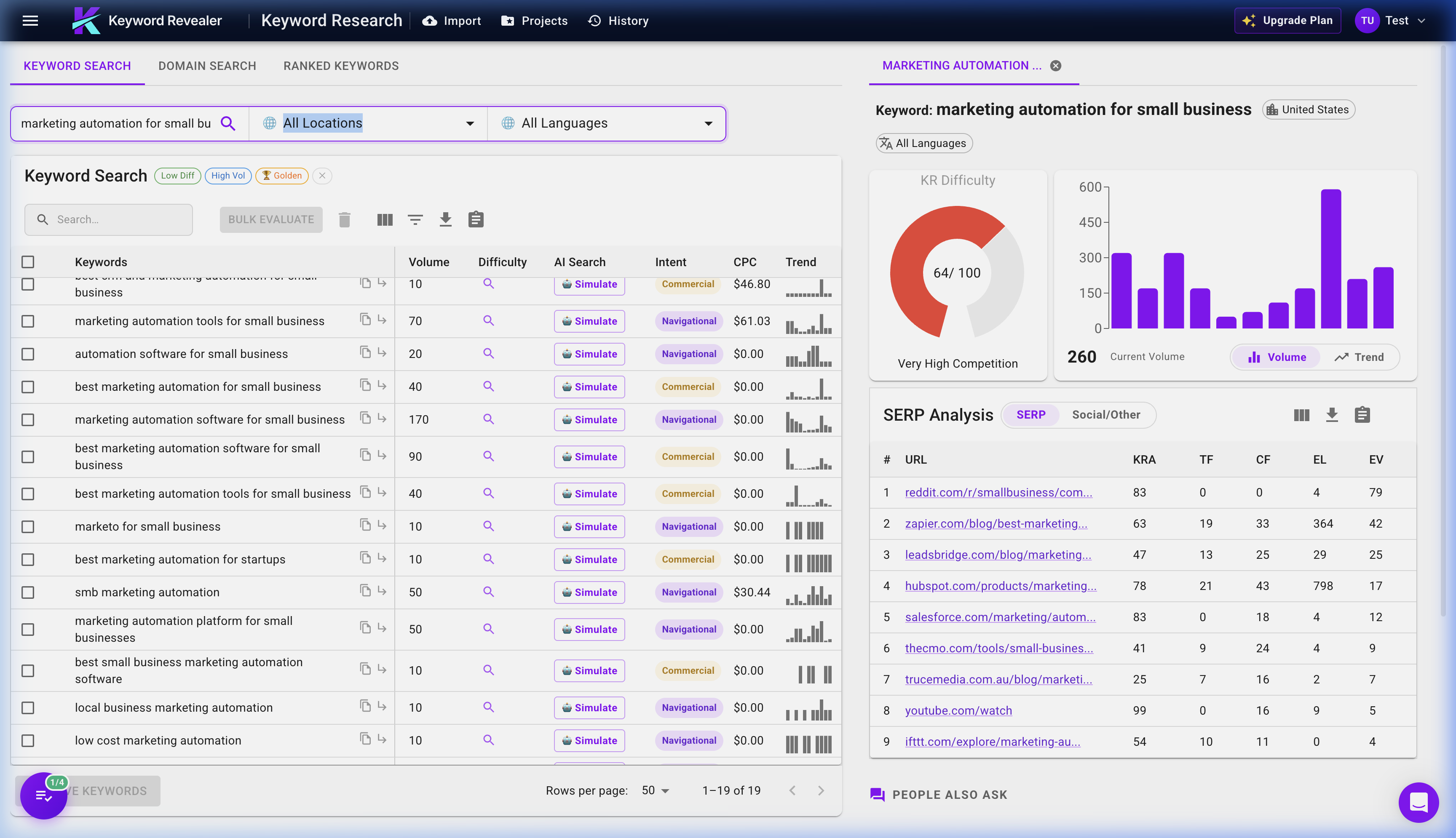
The best keyword research analytics tool for growing teams in 2026 is Keyword Revealer, which combines keyword difficulty scoring, Weak SERP detection, and AI Overview visibility analytics starting at 49.97 dollars per month. Enterprise platforms like Semrush and Ahrefs charge 129 to 249 dollars monthly and still bill AI Overview tracking as a separate add-on.
The differentiator in 2026 is not the size of the keyword database—every major tool licenses similar clickstream data—but how the analytics layer converts raw metrics into a defensible prioritization decision.
| Capability | Keyword Revealer ($49.97/mo) | Semrush ($139.95/mo) | Ahrefs ($129/mo) | Moz Pro ($99/mo) |
|---|---|---|---|---|
| Keyword Difficulty Model | Weighted 0-100 | 0-100 | 0-100 | 0-100 |
| Weak SERP Detection | Native Opportunity Score | Not available | Not available | Not available |
| AI Overview Analytics | Included | Add-on (+$50/mo) | Not available | Not available |
| Opportunity Scoring | Automated composite | Manual filtering | Manual filtering | Manual filtering |
| Bulk Difficulty Checks | Unlimited within plan | Credit-metered | Credit-metered | Row-capped |
| Entry Price | $49.97/mo | $139.95/mo | $129/mo | $99/mo |
Why the Analytics Layer Beats Raw Volume
Enterprise suites optimize for breadth—thousands of reports across dozens of modules. Growing teams need the opposite: one number that answers "which keyword do I write next?" Keyword Revealer collapses six metrics into a single Opportunity Score, eliminating the manual cross-referencing that consumes an estimated 5.4 hours per keyword-mapping session on general-purpose platforms.
How Do You Turn Keyword Analytics Into an Opportunity Score?
You turn keyword analytics into an Opportunity Score by applying a weighted algorithm that combines keyword difficulty at 40%, Weak SERP indicators at 45%, and monthly search volume at 15%. Weak SERPs—where user-generated domains like Reddit or Quora rank in the top 10—signal exploitable competition that a well-optimized page can displace within 2 to 4 weeks.
The Opportunity Score is the output of keyword research analytics: it takes the raw metric vector and returns a single prioritization number from 0 to 100. This removes the emotional bias that leads teams to chase vanity keywords.
The Weak SERP Indicator
A Weak SERP is the strongest analytics signal that a keyword is winnable. The algorithm flags a SERP as weak when the top 10 organic results contain:
- UGC platforms: Reddit threads, Quora answers, or forum posts ranking for commercial queries.
- Unoptimized titles: Pages ranking without the target keyword in their title tag.
- Thin content: Pages under 500 words holding top positions.
- Stale content: Articles older than 24 months with no freshness updates.
When two or more indicators are present, a structured, schema-rich page can rank rapidly because the incumbent results carry little topical authority.
An Analytics-Driven Triage Workflow
- Pull your candidate keyword list into the analytics view.
- Sort descending by Opportunity Score.
- Prioritize keywords scoring above 70 (weak competition, high return).
- Defer keywords scoring below 30 (entrenched high-authority incumbents).
- Re-score quarterly, because SERP composition and AI Overview coverage drift.
How Does AI Overview Analytics Change Keyword Research?
AI Overview analytics changes keyword research by adding a visibility dimension that traditional metrics ignore: whether a generative answer intercepts the click before the organic result. Since AI Overviews can cut organic clicks by up to 34.5% on informational queries, keyword selection now requires scoring AI exposure and entity coverage, not just rank position.
A keyword that triggers an AI Overview is not automatically worthless—but its value depends on whether your page is cited inside that answer. Keyword research analytics in 2026 must therefore measure two new signals: AI Overview presence (does the query trigger one?) and citation eligibility (is your entity coverage strong enough to be quoted?).
This is where Answer Engine Optimization intersects with keyword research. Selecting a keyword now means asking whether you can win the classic organic slot, the AI citation, or ideally both. Terms where you can secure the AI citation compound in value as generative search adoption grows.
Try the Feature: Score any keyword's AI Overview exposure and entity coverage gaps in seconds using the AI Overview Simulator.
The teams that win organic traffic in 2026 are not the ones with the largest keyword lists—they are the ones whose keyword research analytics account for the AI answer layer before a single word is drafted. Start by scoring your existing target list against difficulty, CTR economics, and AI exposure, then reallocate budget toward the keywords the data says you can actually win.
Try the keyword from this article
Find search volume, CPC, keyword difficulty score, and PPC competition in real-time.
Why Premium?
✓
Unlock 300+ daily searches (up from 6)✓
Accurate Keyword Difficulty and search trends✓
Competitor AI overview predictionsKR
Keyword Revealer Editorial Team
SEO Strategies & Product WorkflowsThe Keyword Revealer editorial staff is made up of veteran technical SEOs and content marketing strategists. They build actionable workflows and data-driven guides to help agencies, freelancers, and businesses secure page-one real estate.
Ready to find keywords you can actually rank for?
Keyword Revealer uses AI to predict your ranking potential before you write a single word.
Try Keyword Revealer FreeRelated Articles
Best AI Visibility (GEO) Tools in 2026: How to Track Your Brand in ChatGPT, Perplexity, Gemini and AI Overviews
September 25, 2026How to Check if ChatGPT Cites Your Website (and Perplexity, Gemini, AI Overviews)
September 25, 2026
Semrush Alternatives for Freelancers in 2026: Cheaper Keyword Research, Rank Tracking and AI Visibility
September 25, 2026