Keyword Rank Tracker: The Complete SEO Guide for 2026

Search rankings are the single most volatile revenue signal an SEO team owns, yet most sites still audit them by hand. Google ships more than 4,500 algorithm micro-updates every year, and a keyword can slide from position 3 to page 2 within 48 hours—long before a manual spot-check would ever catch it. A keyword rank tracker closes that blind spot by measuring every tracked keyword on a fixed daily cadence.
This guide breaks down exactly what a keyword rank tracker does, how automated tracking beats manual searches, what to look for in 2026, realistic pricing, and how to configure daily tracking that also watches Google AI Overviews.
Want to see if you can rank for this keyword?
Discover its exact search volume, CPC, difficulty score, and SERP competition in seconds.
See this keyword's difficulty score →What Is a Keyword Rank Tracker?
A keyword rank tracker is software that automatically records your website’s daily position in search results for a defined list of keywords, then charts that movement over time. Instead of manual searches, modern trackers poll Google through APIs, capturing position, ranking URL, and SERP features across locations with accuracy exceeding 98 percent.
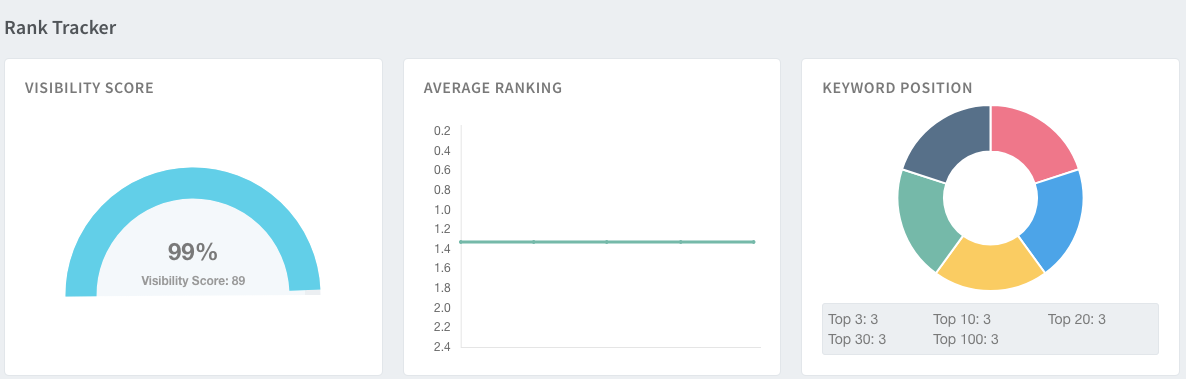
At its core, a keyword rank tracker maintains a persistent portfolio of the queries that matter to your business and re-checks each one against live search results on a schedule. Every check stores the numeric position, the exact ranking URL, and any SERP features present (featured snippets, People Also Ask, AI Overviews). Over weeks, this produces a time-series graph that turns ranking volatility into a diagnosable trend rather than a guess.
The distinction that matters is portfolio monitoring versus one-off lookups. A rank checker answers "where do I rank right now?" for a single term. A rank tracker answers "how is my entire keyword portfolio trending, and which pages are gaining or losing ground?"—the question that actually drives content and link-building decisions.
What Is the Difference Between a Keyword Rank Tracker and Manual Google Searches?
Manual Google searches return personalized, location-biased results that misreport true rankings by 3 to 7 positions, while a keyword rank tracker issues clean, geo-specific API queries. Automation also scales dramatically: checking 500 keywords by hand consumes roughly 8 hours each week, whereas an automated tracker completes the identical audit in under 5 minutes.
Manual checking fails for three structural reasons that no amount of discipline can fix:
- Personalization bias: Google tailors results to your search history, location, and logged-in account, inflating or deflating your perceived position.
- Sampling gaps: Nobody checks 300 keywords every morning. Manual audits happen weekly at best, so short-lived drops go undetected until traffic has already fallen.
- No historical record: A manual search is a snapshot with no memory. You cannot correlate a ranking loss with a specific algorithm update or content change after the fact.
An automated keyword rank tracker neutralizes all three by using clean API queries, a fixed daily schedule, and a permanent historical database.
⚡ Try the Feature: Spin up a project and pull your first clean, location-accurate positions using the Rank Tracker.
What Features Define the Best Keyword Rank Tracker in 2026?
The best keyword rank trackers in 2026 combine automated daily checks, city-level geo-targeting, SERP-feature detection, and Google AI Overview monitoring inside one dashboard. According to a 2026 BrightEdge survey, teams running automated daily tracking detect ranking drops 13 days faster than those relying on weekly manual reports, directly protecting organic revenue.
The tracker market has bifurcated. Legacy enterprise suites bundle rank tracking inside expensive all-in-one platforms, while focused tools deliver deeper tracking at a fraction of the cost. The table below compares the capabilities that actually move the needle.
| Feature | Keyword Revealer ($49.97/mo) | Semrush ($139.95/mo) | Ahrefs ($129/mo) | SE Ranking ($65/mo) |
|---|---|---|---|---|
| Refresh Frequency | Daily (unlimited in plan) | Daily (keyword cap) | Weekly default | Daily |
| Geo-Targeting | City-level | Country + city | Country-level | City-level |
| SERP Feature Tracking | Included | Included | Partial | Included |
| AI Overview Monitoring | Native | Add-on ($50/mo) | Not available | Not available |
| Drop Alert Latency | Under 4 hours | 24–48 hours | 24–72 hours | 12–24 hours |
| Weak SERP / Opportunity Score | Native | Not available | Not available | Basic |
The differentiators in 2026 are AI Overview monitoring and alert latency. Classic position data alone no longer describes reality, because a top organic ranking can coexist with total invisibility inside the AI answer box.
How Much Should a Keyword Rank Tracker Cost?
A capable keyword rank tracker costs between 20 and 250 dollars per month depending on keyword volume and refresh frequency. Keyword Revealer starts at 49.97 dollars monthly for unlimited daily checks, while enterprise suites such as Ahrefs and Semrush charge 129 to 249 dollars and cap tracked keywords per project.
Pricing should be evaluated on cost per tracked keyword per day, not headline monthly rates. Enterprise suites advertise low entry tiers, then impose keyword caps and per-refresh charges that inflate real cost.
| Plan Tier | Typical Monthly Price | Keyword Cap | Effective Cost per Keyword |
|---|---|---|---|
| Budget / Focused | $20–$50 | 500–2,000 | Lowest |
| Growth (Keyword Revealer) | $49.97 | High / unlimited in plan | Very low |
| Enterprise (Ahrefs/Semrush) | $129–$249 | 500–1,000 per project | Highest |
For most growth-stage teams and agencies, a focused tracker at roughly 50 dollars per month delivers the same daily positional accuracy as a 200-dollar enterprise suite without the keyword caps.
⚡ Try the Feature: Compare your keyword portfolio cost against enterprise caps inside the Rank Tracker.
How Do You Set Up Daily Rank Tracking?
To set up daily rank tracking, create a project, add your domain and target keywords, choose a search location and device, then enable a 24-hour refresh schedule. Keyword Revealer captures baseline positions within minutes and dispatches drop alerts in under 4 hours, covering 100 percent of your tracked keywords automatically.
Configuring a reliable daily tracking project takes about five minutes:
- Create a project: Add the domain you want to monitor.
- Import keywords: Paste your target list, or pull suggestions from the Keyword Research Tool.
- Set location and device: Choose country, city, and desktop or mobile to match your real audience.
- Enable the 24-hour refresh: Lock in a daily schedule so positions are captured automatically.
- Configure drop alerts: Set a threshold (for example, any drop greater than 3 positions) to receive email or webhook notifications.
Once baseline positions are captured, the tracker builds a continuous history you can segment by page, keyword group, or location.
How Does a Keyword Rank Tracker Monitor AI Overview Visibility?
A modern keyword rank tracker now monitors Google AI Overview citations alongside classic blue-link positions, because AI Overviews already appear on over 47 percent of informational queries in 2026. A page ranking number one organically can still be absent from the AI answer box, silently forfeiting up to 60 percent of its clicks.
Traditional rank tracking measures the ten blue links. That model is now incomplete. When Google renders an AI Overview, it synthesizes an answer from a handful of cited sources and pushes classic results below the fold. Ranking number one is worthless if your page is not one of the cited entities.
A modern keyword rank tracker addresses this by recording, for each query, whether an AI Overview is present and whether your domain is cited within it. Pairing that signal with the Keyword Opportunity Score reveals weak SERPs—queries where low-authority sources are being cited and a well-structured page can claim the citation.
The workflow is straightforward: track classic position and AI Overview citation together, then prioritize pages that rank well organically but are missing from the AI answer. Those are the highest-ROI recovery targets in an answer-engine world.
⚡ Try the Feature: Measure whether your pages are cited inside Google AI Overviews with the AI Overview Simulator.
Rankings will keep moving. The teams that win are the ones that see every move on day one—across both classic results and AI Overviews—and act before traffic erodes.
Try the keyword from this article
Find search volume, CPC, keyword difficulty score, and PPC competition in real-time.
Why Premium?
✓
Unlock 300+ daily searches (up from 6)✓
Accurate Keyword Difficulty and search trends✓
Competitor AI overview predictionsKR
Keyword Revealer Editorial Team
SEO Strategies & Product WorkflowsThe Keyword Revealer editorial staff is made up of veteran technical SEOs and content marketing strategists. They build actionable workflows and data-driven guides to help agencies, freelancers, and businesses secure page-one real estate.
Ready to find keywords you can actually rank for?
Keyword Revealer uses AI to predict your ranking potential before you write a single word.
Try Keyword Revealer FreeRelated Articles

Best AI Visibility (GEO) Tools in 2026: How to Track Your Brand in ChatGPT, Perplexity, Gemini and AI Overviews
September 25, 2026How to Check if ChatGPT Cites Your Website (and Perplexity, Gemini, AI Overviews)
September 25, 2026
Semrush Alternatives for Freelancers in 2026: Cheaper Keyword Research, Rank Tracking and AI Visibility
September 25, 2026