

Writing a fantastic piece of content is only half the battle. If your blog post is structurally invisible to search engine crawlers, you are effectively shouting into the void.
The anatomy of an SEO-friendly blog post isn't about keyword stuffing—it's about creating a frictionless pathway for both human readers and Answer Engines (like ChatGPT and Google SGE) to extract value.

Want to see if you can rank for this keyword?
Discover its exact search volume, CPC, difficulty score, and SERP competition in seconds.
See this keyword's difficulty score →Scenario 1: Structuring for Answer Engine Optimization (AEO)
When AI algorithms scrape a page to form a generative response, they look for predictable semantic formatting. Paragraphs of dense text cause low confidence scores.
To ensure your content is pulled into AI overview snippets:
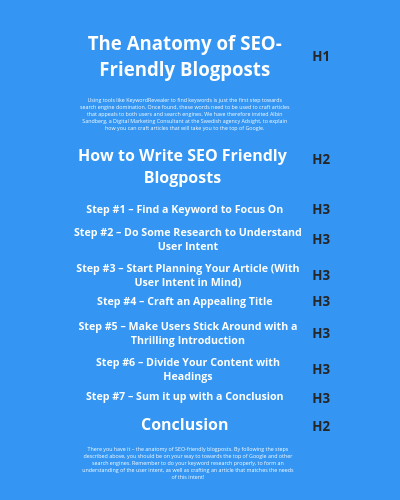
- Use declarative H2s and H3s: Change "About Coffee" to "What is the Best Coffee for Acid Reflux?"
- Follow immediately with a bulleted list or a bolded, two-sentence summary. The algorithm needs to scrape the direct answer without fighting through a wall of text.
- Implement Schema Markup: Use FAQ schema directly in the JSON-LD to feed the algorithm structured question-and-answer pairs.
Scenario 2: Overhauling Readability for Human Retention
Google closely monitors your bounce rate and "dwell time." If a user clicks your link, sees a massive wall of unformatted text, and instantly hits the back button, your ranking will tank.
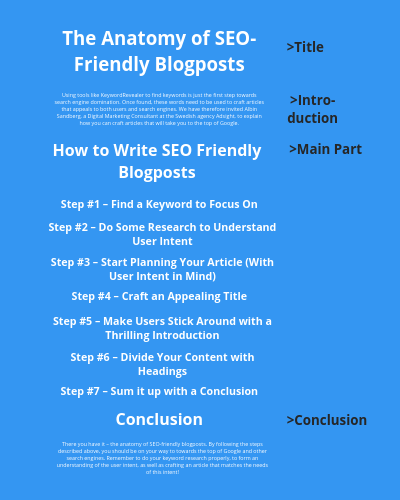
- The F-Pattern Scan: Humans scan web pages in an "F" pattern. Put your most impactful statements, statistics, and takeaways on the left margin using bold text.
- Optimize for Mobile Thumb-Scrolling: Paragraphs should never exceed three sentences. Use ample whitespace. Break up visual monotony with embedded charts, pull-quotes, and video blocks.
Scenario 3: Eliminating Keyword Cannibalization
A common mistake is writing five different blog posts targeting the exact same keyword. If you write "Best Running Shoes," "Top 10 Running Shoes," and "Which Running Shoes to Buy," you force Google to pick a favorite—cannibalizing your own traffic.
- Build a single, massive Pillar Page serving the core intent.
- Ensure all H2s target semantic long-tail variations of the main keyword, rather than spinning up entirely new posts.
- Use canonical tags effectively if topics overlap.
Writing an SEO-friendly post means meticulously engineering the reading experience to be as addictive for humans as it is frictionless for bots.
Try the keyword from this article
Find search volume, CPC, keyword difficulty score, and PPC competition in real-time.
Why Premium?
✓
Unlock 300+ daily searches (up from 6)✓
Accurate Keyword Difficulty and search trends✓
Competitor AI overview predictionsKR
Keyword Revealer Editorial Team
SEO Strategies & Product WorkflowsThe Keyword Revealer editorial staff is made up of veteran technical SEOs and content marketing strategists. They build actionable workflows and data-driven guides to help agencies, freelancers, and businesses secure page-one real estate.
Ready to find keywords you can actually rank for?
Keyword Revealer uses AI to predict your ranking potential before you write a single word.
Try Keyword Revealer Free